Search This Blog

Showing posts with label Information Technology. Show all posts

Tuesday, 6 August 2013

Causes of Job Stress


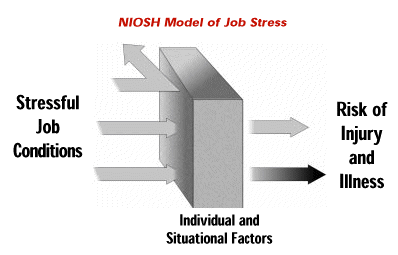
Job stress is caused by so many factors or forces and they are called stressors. These stressors tend to threaten the existence and well-being of the individual and the way he/she responds to the threat (Lazarus, 1966). The major sources or causes of job stress is categorized into the physical, psychological and environmental, it could include personal injuries, illness, lack of sleep, other deformities such as blindness, amputation and exhaustion and these tend to put the individual in an incapable state where he/she can do nothing.

        Psychological stress occur from reasons that comparatively trivial or even in the situations that are pleasurable, while environmental stress involves noise from cars, buses, lories and industrial machineries. Cooper and Marshall (1978) identified six causes of job stress. These are factors intrinsic to job, role stress (conflicts) relationship at work, career stress (i.e. job insecurity), under-promotion, organizational structure and climate and interface between work and home. In the same vein Adeoye (1992) explained that the three key factors causing stress are factors intrinsic to the job itself, individual characteristics and loss of control.
        Frustration is also another factor of job stress which is directed towards us by parents, siblings, friends, co-staffs, machine which breakdown just when we need to use it, the interruption when carrying our work which forces us to do something, the score which we are trying to have that is not coming all of these are small frustration. If these numerous frustrations become too numerous and we allow them to affect us well, we will soon be faced with an intolerable level of stress as dangerous as if it has come from one giant stress factor.

STAGES OF STRESS


i.    The Alarm Stage: This is a warning stage, this stage clearly signals the presence of stress agents in the body, and in turn there are physical reactions which tend to be the first to appear. These reactions warns the individual that he has to be on guard as there are stress agents present in the body, and once the individual is aware of these, he or she can take measures to face the problem and solve them. When this is done the effects or aftermath of stress is reduced or not materialized at all. Stress may be from one or multiple sources combined together.

ii.  The Resistance Stage: When stress is not curtailed during the alarming stage, it goes further to enter into the resistance stage. In this stage the individual will start to notice some signs that will slow his/her action down. The individual might suddenly realize that he is losing lot of energy and conduction level of the body becomes lower than usual. At this stage something needs to be done in order for him/her to survive, and he/she does not know that he/she is in a vicious circle, then tries to complete the task ahead but finds out that it is practically impossible and this calls for major concern to him/her as failure is not an option given the task in hand.
iii.The Exhaustion Stage: This stage is the final stage and is characterized by fatigue, accompanied by nervousness, irritability, tension and anger. The individual becomes anxious and not only when he/she is faced by stress factors but also in moments which would not normally produce any anxiety. This further leads to depression and this means lacking pressure in an activity or activities, the individual suffers from dizziness and the thoughts of the individual are pessimistic and negative.

Wednesday, 31 July 2013

Challenges of Information and Communication Technology


Some of the challenges of information and communication technology according to Kanno and Onyechu (2009) are:
1.  Lack of Expertise Knowledge on the Use of ICT: Majority of the teachers in Nigerian schools are computer illiterates. This is a very big problem militating against the use of ICT in commerce teaching.

2.  Lack of Computers in Nigerian Schools: In most schools there are no computers for learners use, in some where they are available, and they are inadequate. A situation where there is only one computer donated by a philanthropist in a school makes one to wonder how the entire students can learn with only one computer. In a situation where there is none, it means that none will be used in the school for all round development of the child. Lamenting on the damages done by lack of access to computer, Tuoyo (2007) stressed that inability to access computers mean creating more social illiteracy and economic denial of the right of children especially the exceptional children to fully participate in the school system and in the society at large.
3.  Lack of Awareness of Instructional Values of ICT Facilities: Teachers are not aware of the instructional value of ICT facilities. This prevents them for using them.
4.  Teachers Unwillingness to Integrate ICT in their Teaching: Most teachers are unwilling to integrate ICT in teaching. Even if they are computer literates, many prefer to use that knowledge of computer in making business instead of using them in teaching.
5.  Problem of Electricity: Lack of electricity is another constraint militating against the use of ICT in teaching. Since ICT facilities require electricity for them to be functional, where there is no electricity computers will be kept unused.
6.  Inadequate Fund: Fund refers to money needed for executing a project. Computers and other ICT facilities are very expensive, when enough money is not available in the school, ICT facilities will be seen as less important project.
7.  Lack of Personnel for Maintaining ICT Facilities: This is another problem affecting the use of ICT in teaching. In Nigeria, few people are available for maintaining ICT facilities. As a consequence, when any of the accessories break down, the system will be packed waiting for repair, which may take a very long time. On this ground, Mkpa (2007) laments that the required personnel or manpower to maintain the system are very much in short supply.

Tuesday, 30 July 2013

Concept of Information and Communication Technology


Information and Communication Technology is a term used to describe technologies which receive, record, process, transmits and retrieves information (Ebisine, 2011). According to him, ICT is the combination of networks, hardware and software; as well as the means of communication, collaboration and engagement that enable the processing, management and exchange of data,
information and knowledge. ICT also stand for the various ways the computer works together with other telecommunication equipment which are needed in data processing and information transmission to solve different aspects of human endeavor (Eze, 2007). This is probably why it is referred to handling and processing of information using electronic devices (Adeoja, 2002) and as the range of products and systems, which handles, process and produce information using computers and/or telecommunication technologies. In one sense, Eguridu (2008) presented ICT as a technology that merges computer with high speed communication links carrying data sounds and videos. ICT he emphasized is an umbrella term that refers to all technology for communication of information. According to him, it includes any medium to record information that is paper, magnetic disk flash.
        ICT is a process of networking – connecting any part of the world by mere touching a combination of keyboard buttons on electronic device like radio, television, telephone, computer and so on with this innovation in our ever changing society, it is crystal clear that more pressure will be on the young people mostly students. Thus, the need to fully inculcate ICT into the Nigerian education system in order to gradually bring them to the reality of the universal phenomenon comes to play (Orukokan, Olaleye, Odumosu and Akinneye, 2009).
        Adedoja (2002) contended that ICT is concerned with handling and processing of information using electronic devices. Agboola (2001) presented ICT as the range of products and systems, which handle process and produce information using computers, and/or telecommunication technologies. In effect, ICT is a process of networking – connecting any part of the world by mere touching a combination of keyboard buttons on electronic devices like radio, television, telephone, and computer and so on. This is in line with Ayannuga (2006) that ICTs are information handling tools. They include the old ICTs of radio, television and telephone and the new ICTs of computer, satellite and wireless technology and the internet. According to him, information and communication technology is a general term sometimes used to refer to a variety of tools, all of which make it possible to improve dialogue between individuals and groups.
        ICT according to Bamikole (2000) is the creation, collection, storage, processing, transmission, displaying and use of information by people and machine. It encompasses so many a concept among which is the internet. Abimbade (2006) observed that development in computer technology and telecommunication networks had given rise to the internet and intranet, thus information and communication are interwoven and one is dependent of the other. ICT is the fusion of Information Technology (IT) and Communication Technology (CT).

Strategies to Overcome the Challenges of Information and Communication Technology


To meet the challenges the following needs to be ensured:
-      Creating public awareness for ICT and encouraging students’ interest.

-      Integrating ICT in all subject areas in the educational system.
-      Government should ensure and monitor the implementation of ICT application at all levels of our educational system as contained in the National Policy on Education (2004).
-      Provision of ICT materials in all Nigerian schools.
-      Continuous ICT in-service training for all teachers.
-      Motivation and incentive giving for all ICT trainees.
-      Enabling technology for the physically challenged in our society.
-      Government should invest on ICT facilities in such areas as procurement of equipment, infrastructure and ICT centres.
-      Monitoring of ICT programmes and project implementation.
-      Integrating ICT into all teacher education programmes.

Summary of Literature Review

The review of literature provided the meaning of Information and Communication Technology (ICT) as a whole range of facilities or technologies involved in information processing and electronic communication. Also the reviewed literature recognized the relevance of ICT in which there was a general agreement that ICT helps learners in the acquisition of four basic language skills of listening, speaking, reading and writing. The reviewed literature identified the ICT resources for effective teaching such as Computer Aided Instruction (CAI), multimedia, distance learning, e-learning and web-based instruction.
        Finally, the literature also provided some challenges to ICT in effective teaching and learning. Finally, the literature review highlighted the strategies to overcome the identified challenges to ICT.